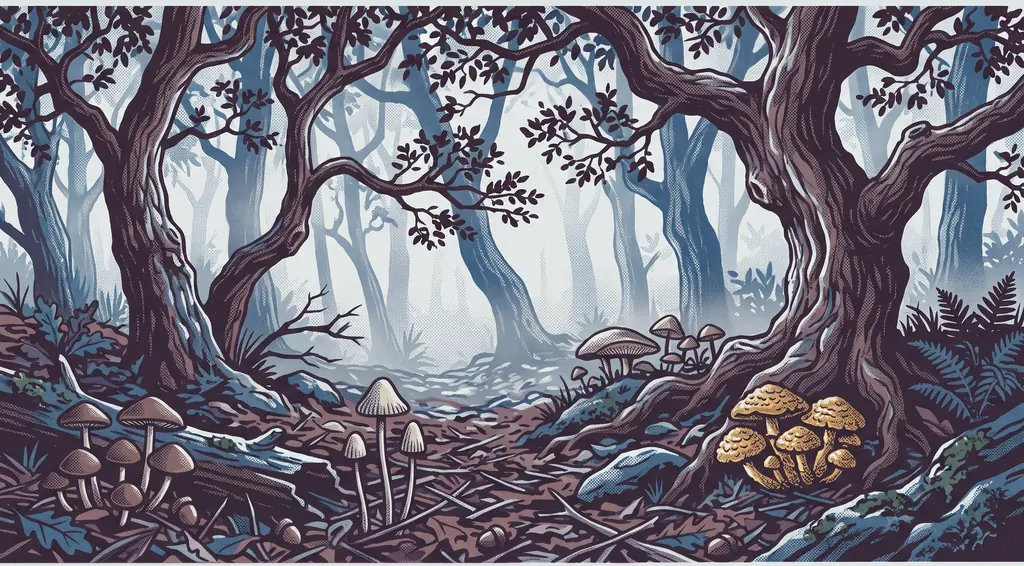
San Diego County has a real mushroom season, and some of what comes up after the rain can kill. Most local mushrooms appear from December through April, peaking in January. Death caps have now been documented here, the western destroying angel is common under oaks, and wild psilocybin mushrooms are rare and easy to confuse with deadly ones. County health officials' advice is short: don't eat wild mushrooms.1
When is mushroom season in San Diego?
Rain sets the season, not the calendar. Of the county's 77,000-plus verifiable fungus records on iNaturalist, about 68% were logged between December and April, and January alone accounts for about 20%. June, July and August each hold only 3 to 4%.2 Those counts include lichens and grow as people add sightings, so treat them as a pattern, not a census (figures here are as of October 20, 2026).
Wet winters change everything. After the heavy rain of 2016 and 2017, KPBS reported an unusual flush of mushrooms around the county, and the San Diego Mycological Society's founder joked that in drought years, mushrooming here "was for masochists."3 The County's health advisory lists where they appear once the ground is soaked: parks, canyons, open spaces, coastal foothills and residential yards.4
Where mushrooms grow in the county
- Under oaks. Coast live oak woodland across inland North County and East County is home to the western destroying angel, and death caps have been found under planted, non-native oaks.5,6
- Mountain forests. The pine and oak forests around Palomar Mountain and Julian, where small brown wood-rotters such as deadly galerina turn up on rotting logs.7
- Mulch and wood chips. Irrigated landscaping in neighborhoods, campuses and parks, home to a crowd of small brown mushrooms, including the deadly Pholiotina rugosa.8
- Lawns and watered ground. The green-spored parasol, the county's most-recorded poisonous lawn mushroom, lives here.9
The summer exception. The green-spored parasol runs on the opposite clock. More than half of its 1,228 county records fall in August and September, on irrigated lawns, at the time of year most people assume it isn't mushroom season.9
Are there death caps in San Diego?
Yes. Death caps (Amanita phalloides) have been confirmed in San Diego County, though they're still uncommon. iNaturalist holds 22 research-grade county records from 2021 to 2026, from Fallbrook, Escondido, Vista, Carlsbad, Encinitas, Oceanside, parts of the City of San Diego and Descanso. Ten of those records come from the November 2025 to January 2026 season alone, and one observer logged five fruiting bodies under a non-native oak in May 2026.6 The County said it plainly in May 2026: death cap and other amanita-containing varieties "can be found in San Diego County."1
The deadly mushroom San Diego has always had is the western destroying angel (Amanita ocreata). It's the county's common amatoxin species, with 330 verifiable records, about 80% of them from January through March, under coast live oaks from Escondido and Poway to Ramona, Jamul and Campo.10 MykoWeb lists it as deadly poisonous.5
Both species carry amatoxins, which cooking, boiling, freezing and drying don't destroy.11 NBC News reported that a piece the size of a sugar cube can be fatal.12 MykoWeb notes the death cap is becoming more common in parts of California where oaks are common, and that it fruits in watered areas outside the normal season.13
Last season showed what that means. California logged 50 amatoxin poisonings between November 2025 and May 22, 2026, with 4 deaths and 4 liver transplants. A typical year has fewer than 5.11 None of the patients were treated in San Diego County, and the mushrooms were picked in neighborhoods, local and regional parks, nature preserves and at least one national park.14 We cover what that means for the coming season in our death cap season report.
The mushrooms that can hurt you here
These are the species San Diegans most need to know. Counts are verifiable iNaturalist records for San Diego County as of October 20, 2026. A record means someone photographed it here, so absence from a list never means a mushroom is safe.
Western destroying angel
Amanita ocreata
- Where
- Under coast live oaks, inland North County and East County
- When
- January to March, about 80% of records
- Why it matters
- The county's most common amatoxin mushroom: 330 records. White, and easy to mistake for edible white amanitas.10
Death cap
Amanita phalloides
- Where
- Under oaks, often planted European or other non-native oaks; North County, San Diego and Descanso
- When
- Winter, including 10 records from November 2025 to January 2026, plus a May 2026 flush
- Why it matters
- One of the amatoxin species behind California's record 2025 to 2026 poisoning season. Documented here since 2021.6,11
Pholiotina rugosa
Small brown mushroom of mulch beds
- Where
- Urban mulch and landscaping countywide, from Point Loma to Vista and Chula Vista
- When
- December to March, plus September and October
- Why it matters
- Contains amatoxins, grows in irrigated wood chips, and is easily mistaken for other small brown mushrooms, including psychedelic ones.8
Deadly galerina
Galerina marginata
Green-spored parasol
Chlorophyllum molybdites
- Where
- Watered lawns and parks across the city, Chula Vista, Carlsbad, Oceanside and Encinitas
- When
- July to October
- Why it matters
- Large, common (1,228 records) and a cause of severe stomach illness. It looks like edible parasols.9
Western jack-o'-lantern
Omphalotus olivascens
- Where
- At the base of oaks and on buried roots
- When
- November to March, peaking in January
- Why it matters
- One of the most-recorded mushrooms in the county (1,561 records) and sometimes mistaken for chanterelles.15
Yellow-staining agaricus
Agaricus xanthodermus, A. californicus
Wild Psilocybe species
Psilocybe spp.
- Why it matters
- About 60 county records since 2006, and easy to confuse with deadly small brown mushrooms such as Pholiotina rugosa and galerina.18
What does amatoxin poisoning look like?
The danger with death caps and destroying angels is the delay. The County's health advisory describes three phases:4
| Phase | When | What happens |
|---|---|---|
| Stomach | 6 to 24 hours after eating | Nausea, vomiting, stomach pain and diarrhea, often mistaken for a stomach bug |
| False recovery | 24 to 36 hours | Symptoms ease, which can look like the person is getting better |
| Liver | 36 to 96 hours | Liver injury, bleeding problems, jaundice, confusion, kidney injury and possible liver failure |
Don't wait for symptoms. If anyone ate a wild mushroom that wasn't identified by an expert, call Poison Control at 1-800-222-1222 now. The California Department of Public Health's advice is to get help immediately, even if the person feels fine.11
In the 2016 Northern California outbreak, symptoms started 7 to 12 hours after eating and were first mistaken for gastroenteritis before liver failure set in. Three of the 14 patients needed liver transplants.19
Do magic mushrooms grow wild in San Diego?
Barely, and the ones that do are the riskiest mushrooms to hunt. There are only about 60 verifiable Psilocybe records in the whole county since 2006. For comparison, there are 1,228 green-spored parasol records and 330 destroying angel records. The classic cubensis "cow pasture" mushroom has no county records at all.18
The bigger problem is what they're confused with. The deadly Pholiotina rugosa is a small brown mushroom of irrigated mulch,8 and deadly galerina is another small brown mushroom.7 This isn't hypothetical. In the 2016 California outbreak, 4 of the 14 people poisoned were young men who thought they were picking psychedelic mushrooms and ate death caps instead.19
Phone apps don't solve it. Times of San Diego reported that foragers relying on identification apps that can mislabel death caps as edible are part of why poisonings are rising,20 and state health officials tell foragers to rely on local experts, not apps or websites.21 Picking in city parks is also illegal (see the rules below), and psilocybin itself is a controlled substance in California. Our guide to San Diego's psilocybin laws covers what that means.
We don't publish locations for wild psilocybin mushrooms. The habitat they share with amatoxin species makes a "where to find them" page a poisoning risk.
Edible mushrooms grow here too, but leave them to experts
Shaggy manes, blewits, oyster mushrooms, sulphur shelf (often on eucalyptus) and blushing morels in wood chips are all recorded in the county. California golden chanterelles are rare, with about 10 records, all from January to March under coast live oak.22 Several edible amanitas grow here as well, and MykoWeb warns that their white forms should be avoided by all but experts because they can be confused with destroying angels and death caps.5 The County's health officer put the safe option simply in December 2025: "Store-bought mushrooms are the safest choice."23
Is it legal to pick mushrooms in San Diego?
On most public land, not without permission. Here's how the rules break down by who owns the ground:
| Land | Rule | What it means |
|---|---|---|
| State parks | 14 CCR §4306 | No picking any plant or "portion thereof" unless the park unit posts authorization to gather mushrooms at its headquarters. Where allowed, it's personal use only, up to 5 pounds a day.24 Torrey Pines, Cuyamaca Rancho, Palomar Mountain and Anza-Borrego are state park units; ask the unit before assuming anything is allowed. |
| Cleveland National Forest | 36 CFR §261.6(h) | Removing any forest product without authorization is prohibited.25 The forest doesn't publish mushroom-specific rules, so call the Supervisor's Office (858-673-6180) before collecting. |
| County parks | County Code §41.111 | Removing any plant or "other vegetation" without written authorization from the parks department is unlawful.26 |
| City parks and open space | SDMC §63.0102(c)(4) | Removing natural vegetation in any City park without written permission of the City Manager is unlawful.27 That covers Balboa Park, Mission Trails and the City's canyons, where the City says all plants and animals are protected.28 |
Fungi aren't named in every rule, but the language covers plants and vegetation broadly. This is general information, not legal advice.
Dogs, kids and backyard mushrooms
Dogs died during last season's statewide outbreak too.14 If a pet eats a wild mushroom, call the ASPCA Animal Poison Control Center at 1-888-426-4435 or your vet right away.1 State health officials recommend pulling up mushrooms wherever children and pets play, especially after rain.21 Bag them rather than composting them where a dog can dig them up.
Where to learn mushroom identification in San Diego
The San Diego Mycological Society is the place to start. It runs free public talks at Casa del Prado, Room 101, in Balboa Park, with a free mushroom ID session at 6:30 p.m. before the 7 p.m. lecture.29,30 The next listed talk is "Fungi of New Zealand" with Christian Schwarz on Monday, November 2.31
The society also holds an annual Fungus Fair. The 29th fair was held on February 1, 2026, at Casa del Prado, with live specimens, talks, a wild mushroom cooking demo and about 26 vendors, plus members-only forays the day before.32 The 2027 date hadn't been posted as of October 20, 2026; past fairs have run between late January and mid-February. Membership also gets you on forays led by people who can tell a destroying angel from an edible amanita.
What to do if someone ate a wild mushroom
- Call Poison Control at 1-800-222-1222, even if there are no symptoms. It's free, available 24 hours a day and has interpreters in more than 200 languages.33
- Call 911 for severe vomiting, confusion, trouble breathing, a seizure or anyone who can't be woken.
- Keep the evidence. Save any leftover mushroom or take photos, and note where it grew. Health officials ask foragers to photograph and record locations for exactly this reason.21
- Don't wait out a "stomach bug" that starts hours after eating wild mushrooms. That's the classic amatoxin pattern.19
For other kinds of mushroom emergencies, including bad reactions to psilocybin and unknown edibles, see our psilocybin safety guide. If the problem was a smoke-shop gummy or chocolate bar, our guide to what's in those products explains what testing has found.
Questions people ask
When is mushroom season in San Diego?
Mostly December through April, with January the peak month, based on about 68% of the county's iNaturalist fungus records. The big exception is the poisonous green-spored parasol, which comes up on watered lawns from July to October.
Are there death cap mushrooms in San Diego?
Yes. Death caps have been confirmed in San Diego County since 2021, under both planted and native oaks in North County, parts of the City of San Diego and Descanso, and the County confirmed it in May 2026. The western destroying angel, another deadly amanita, is far more common here.
Do magic mushrooms grow wild in San Diego?
Rarely. There are only about 60 verifiable Psilocybe records in the county since 2006, and the cubensis type has none. They're easy to confuse with deadly small brown mushrooms such as Pholiotina rugosa, which is why hunting them is dangerous.
Can I use an app to identify wild mushrooms?
Not safely. Identification apps have mislabeled deadly species, and California health officials tell foragers to rely on local experts instead. The San Diego Mycological Society runs a free ID session before each of its public talks.
Is it legal to forage mushrooms in San Diego?
Not in most parks without permission. State parks ban picking unless a unit posts authorization, Cleveland National Forest requires authorization to remove forest products, and County and City park rules prohibit removing vegetation without written permission.
What should I do if my dog ate a wild mushroom?
Call your vet or the ASPCA Animal Poison Control Center at 1-888-426-4435 right away, and bring a sample or photo of the mushroom. Amatoxin symptoms can be delayed, so don't wait for your dog to get sick.
Is there a mushroom club in San Diego?
Yes. The San Diego Mycological Society holds free public talks with mushroom ID sessions at Casa del Prado in Balboa Park and runs an annual Fungus Fair, usually in late January or February.
Sources
- County Warns Residents as Amatoxin Mushroom Poisonings Rise. County of San Diego News Center, May 21, 2026.
- Fungi observations, San Diego County (verifiable records, monthly histogram). iNaturalist, accessed October 20, 2026.
- Which San Diego mushrooms are poisonous?. KPBS, March 1, 2017.
- Health Advisory: Amatoxin mushroom poisoning (CAHAN San Diego). County of San Diego Health and Human Services Agency, December 18, 2025.
- Amanita ocreata. MykoWeb, California Fungi, accessed October 20, 2026.
- Amanita phalloides, San Diego County (research-grade records). iNaturalist, accessed October 20, 2026.
- Galerina marginata, San Diego County. iNaturalist, accessed October 20, 2026.
- Pholiotina rugosa, San Diego County. iNaturalist, accessed October 20, 2026.
- Chlorophyllum molybdites, San Diego County. iNaturalist, accessed October 20, 2026.
- Amanita ocreata, San Diego County. iNaturalist, accessed October 20, 2026.
- CDPH Warns of Rising Illnesses from Ongoing Unseasonal Bloom of Poisonous Wild Mushrooms (NR26-023). California Department of Public Health, May 22, 2026.
- California third resident dies of death cap mushroom poisoning. NBC News, January 2026.
- Amanita phalloides. MykoWeb, California Fungi, accessed October 20, 2026.
- Outbreak of Severe Illness and Deaths Linked to Ingestion of Poisonous Wild Mushrooms, May 2026 Update. California Department of Public Health, May 14, 2026.
- Omphalotus olivascens, San Diego County. iNaturalist, accessed October 20, 2026.
- Agaricus xanthodermus, San Diego County. iNaturalist, accessed October 20, 2026.
- Agaricus californicus, San Diego County. iNaturalist, accessed October 20, 2026.
- Psilocybe, San Diego County (all species): iNaturalist API count of verifiable records. iNaturalist, accessed October 20, 2026.
- Amanita phalloides Mushroom Poisonings, Northern California, December 2016 (MMWR 66(21):549-553). Centers for Disease Control and Prevention, June 2, 2017.
- Mushroom foraging is on the rise statewide, county says, as is mushroom poisoning. Times of San Diego, May 22, 2026.
- Health Advisory Update #1: Amatoxin mushroom poisoning (CAHAN San Diego). County of San Diego Health and Human Services Agency, May 19, 2026.
- Cantharellus californicus, San Diego County. iNaturalist, accessed October 20, 2026.
- County health officials issue warning: Don't forage for or eat wild mushrooms. Times of San Diego, December 19, 2025.
- 14 CCR § 4306, Plants. Legal Information Institute, Cornell Law School, accessed October 20, 2026.
- 36 CFR § 261.6, Timber and other forest products. Electronic Code of Federal Regulations, current as of October 1, 2026.
- San Diego County Code, Article 2 (County parks rules), §§ 41.111 and 41.114. County of San Diego Parks and Recreation, accessed October 20, 2026.
- San Diego Municipal Code, Chapter 6, Article 3, Division 1 (§ 63.0102). City of San Diego, September 2024 edition.
- Open Space Parks rules. City of San Diego Parks and Recreation, accessed October 20, 2026.
- San Diego Mycological Society. San Diego Mycological Society, accessed October 20, 2026.
- Wild & Local: Mushroom Foraging in Southern California. San Diego Mycological Society, September 12, 2026.
- Fungi of New Zealand. San Diego Mycological Society, October 4, 2026.
- Fungus Fair 2026. San Diego Mycological Society, accessed October 20, 2026.
- California Poison Control System. University of California, San Francisco, accessed October 20, 2026.